Wednesday, 2 July 2014

ISIS............. deadlier version of Al Qaeda


*    Iraq burns, and the world watches with abated breadth as Al Qaeda's newer and deadlier version captures city after city. And what an irony that America remains a mute spectator to all this. After so many days when ISIS has entire Sunni and Kurd regions and some oil refineries under their control, Obama talks of action in a cautious tone. 


          *     This man, the Iraqi Premier, Nouri-Al-Malliki, is 
       responsible for Iraq's descent into chaos. He, like
       Morsi, after assuming power forgot that he was given
       mandate for uniting the country. Muslim leaders have
       to take lesson from Mandela, who through 'Truth and 
       Reconciliation Commission' successfully made two
       communities to forget century-old animosity and 
       come together in nation building. 
      

Friday, 13 June 2014

Egypt..............Morsi to Sisi, An opportunity lost.


*     What an irony? Egypt, from Morsi to Sisi, has travelled back into time. Like many western observers one might be tempted to blame General Sisi for killing the child of democracy in the land of oldest civilisation, but I would rather blame Morsi for this situation to develop in this great country.

*     When Morsi was elected as the first truly elected President of Egypt, he forgot that he was President of whole country not that of Muslim Brotherhood. He behaved like an autocrat, worse than Mubarak and allowed the army to come back to power again.  

*      A great opportunity lost for Egypt. It's time the elected leaders in the Muslim world realised that fundamentalism and bigotry have no place in the present day society. Like other nations, the Muslim countries too are yearning for democracy. 

Sunday, 1 June 2014

India's Unsung Heroes........Alha and Udal


*   Alha of the Banaphar Rajput clan in the Bundelkhand region of India was the famous general of the great Chandel King Paramdidev, or Parmal, who fought Prithviraj Chauhan in 1182.  Alha's mother, Devaki, was from the Ahir caste.  The Ahirs are considered one of the oldest peasants in india.

*      Alha had a sword given to him by Parmal, the ruler of Mahoba. The sword was said to be from heaven and no weapon could match its fury. People who listen to a recital of the Alha-Khand are filled with a warrior spirit and fearlessness. They honour the code of the Kshatriya warriors and the courage shown in the gruesome, difficult battles fought by them.

*   Udal (Udai Singh) was also a Rajput general in the army of Chandel King, Parmal of Mahoba in 12-13th century AD. He was younger brother of Alha. Parmal raised Udal as his own son, since he was born after the death of his father Dassraj,  a general killed in the service of Parmal.

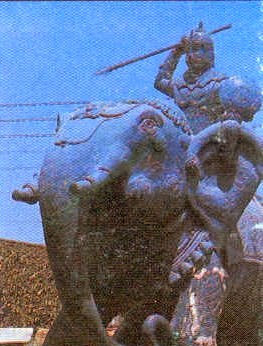
*    Udal was generally seen on a horse whereas Alha, on an elephant. Both were great warriors of Bundelkhand. Out of total 52 battles fought by these Banaphar rajputs, Udal alone had won 22 battles. Alha Udal bade ladaiya jinse haar gayi talwar (meaning "Alha and Udal were such great fighters that even swords were defeated by them"), the folklore of Alha and Udal, is still sung in the heartland of Bundelkhand. According to folklore, Alha was invincible, made immortal by the goddess Sharda. The shrine of the goddess is at Maihar in Madhya Pradesh (India). Alha gifted his head to Sharda after cutting it off with a sword. The goddess, extremely pleased by the act, made him immortal. Alha also had two maternal brothers, Malkhan and Sulkhan. Malkhan had enormous strength, represented in the sentence, "das das haathi bhuj par taule" (meaning "ten elephants were weighed by him on one hand").

*   The last battle fought by these great warriors was when Prithviraj Chauhan declared war on Mahoba. During the battle the Mahoban army was split into three different sections. One was led by the Prince of Mahoba, while the other two were led by the brothers, Alha and Udal. Chauhan defeated the sections under Udal and the Prince. Udal had injured Pundir, a friend and general of Chauhan, in combat. Udal moved forward and injured Chauhan so badly that he could hardly move. Chauda Rai, in an attempt to save his friend Prithviraj, killed Udal in the combat. Alha, commander of the third section, had seen Chauhan falling injured. As soon as he moved forward to kill Prithviraj Chauhan, his guru Gorakhnath came in the way. The guru forbade him not to take revenge of his brother's death but to think for the welfare of the entire rajput state. Alha spared the life of Chauhan and went to the Himalayas.

*  In the Bundelkhand region, Alha and Udal are worshipped as gods. In the poems that are recited all over the region, when people sit around the fire and recite these poems.

*    It’s indeed sad that their chivalry and sacrifice is little known outside the small Bundelkhand region of India. When I see a movie like El Cid, made by the Hollywood, I feel sad that Alha and Udal, who were greater warriors than the Spanish military leader who went on to become a national hero, while Alha and Udal  have been abandoned by their own nation. In today’s world when movies and TV spent thousands of hours on stupid and frivolous programmes, none of the producers thinks of telecasting this great story, or filmmakers make a movie on their lives.

*  In life they fought enemies, in death they fight anonymity. What a tragedy!! And what a shame for the nation…………

Sunday, 25 May 2014

Life's Greatest Lessons............... (1)


Hi,
*     Most folks learn their life's greatest lessons from the great men of the past and the present. I, though, learn my lessons from unknown and illiterate people, who I come across in my daily life. 

*     Until 1990 I  prided myself as a book lover. During a study tour to Mumbai the same year, while walking on the pathway at the Churchgate I saw a bookseller selling English fiction. In an hour at that shop I chose about half a dozen titles, mostly the bestsellers. Each one cost me about ten to twenty bucks. 

*    The man, in mid-forties, whose face I still remember rather well, placed the books on a stool and then took out some ready made transparent plastic covers of different sizes and diligently placed covers on the books chosen by me.

*    To my stupid question why was he wasting money on those covers, his simple reply was, "Sahib, I could never go to a school but these books are my source of livelihood. The transparent covers will protect them from water and dust, and moreover the book's cover is also visible. 

*    His answer left me dumbfounded, his love for books made me ponder if I was actually a better book lover than him. That man that day taught me life's one of the greatest lessons........

        "One doesn't have to literate to be a great book lover."


Wednesday, 14 May 2014

José Mujica.......the World's Poorest President.


Hi Guys,

*     While surfing through news channels, I saw a programme on this GREAT MAN, who is unknown outside Latin America. I thought of sharing this with you all and request you to share it further with your friends and loved ones. What a shame that presidents of the third world live like kings when millions in those countries live below poverty line.    


*      José Mujica,  is the President of Uruguay since 2010. A former guerrilla fighter and as the candidate of the Broad Front, he won the 2009 presidential election and took office as President in  March 2010.
*    Mujica was born on 20 May 1935, to Demetrio Mujica, of Spanish Basque ancestry, and Lucy Cordano, a daughter of Italian immigrants. Mujica's father was a small farmer who went bankrupt shortly before his death in 1940, when his son was five. His mother's parents were  poor immigrants from Linguria. Lucy Cordano was born in Carmelo, where her parents had bought five acres in Colonia Estrella to cultivate vineyards. Between the ages of 13 and 17, Mujica cycled for several clubs in different categories.
* In the early 1960s, he joined the newly formed Tupamaros movement, an armed political group inspired by the Cuban revolution. He participated in the 1969 brief takeover of Pando, a town close to Montevideo, and was later convicted by a military tribunal. Mujica was captured by the authorities on four occasions, and he was among those political prisoners who escaped Punta Carretas Prison in 1971. He was eventually re-apprehended in 1972, and was shot by the police six times. After the military coup in 1973, he was transferred to a military prison. In all, he served 14 years. During the 1970s, this included being confined to the bottom of a well for more than two years.
*     During his time in prison, he remained in contact with other leaders of the Tupamaros, including Frente Amplio Senator Eleuterio Fernandez Huidobro and the founder and leader of the Tupamaros, Raul Sendic. In 1985, when constitutional democracy was restored, Mujica was freed under an amnesty law that covered political and related military crimes committed since 1962.
*  In 2005, Mujica married Lucia, a fellow Tupamaro member, after many years of co-habitation. The couple has no children. Having declined to live in the opulent presidential palace, they live on an austere farm on the outskirts of Montevideo, where they cultivate chrysanthemums for sale. His humble lifestyle is reflected by his choice of an aging Beet as transport. His wife owns the farm they live on. 
*   He is "the world's 'poorest' president", due to his austere lifestyle and his donation of around 90 percent of his $12,000 (£7,500) monthly salary to charities that benefit poor people and small entrepreneurs. 
Related Posts with Thumbnails