Tuesday, 24 February 2015

India's Unsung Heroes.................U Kiang Nangbah.


*       U Kiang Nangbah was born at Tpeppale in Jowai, Meghalaya. He was a child when the British had annexed the Jaintia Kingdom in 1835. He was a common farmer. Though young, he was greatly disturbed by the atrocities committed by the British. The story of his uncle, U Ksan Sajar Nangbah, who fought against the British, greatly inspired him. 

*      The British had left the Jaintia people to themselves for more than two decades. The anti-British feelings in him started when the British attempted to impose taxes and interfered with the custom and religious activities of the people. These acts were viewed by the folks as an attempt by the British to impose their authority.

*      In the darbar, Daloi Tyngkaen had informed the people that the British had imposed a House Tax. U Kiang Nangbah gave a befitting reply there, “Natives do not pay taxes to the foreigners”. When the British officials attempted to collect tax from a Jaintia, he refused to pay the tax. Anger by refusal, the British officials entered and ransacked the house. U Kiang Nangbah arrived there and fought against the armed officials. 

*       A police station was established at Jowai in 1855, to establish the government authority over the hills. The setting of police station near the cremation ground was resented by the people. The British administration took additional measures to control the Jaintias. Deputy Commissioner asked the people not to burn the dead near the military outpost. The clans were prevented to cremate in their traditional cremation sites. 

*      The resistance was triggered by the incident that took place at Yalong. On the occasion of traditional dance, ‘Pastieh Kaiksoo’ the police confiscated the weapons meant for the festival and burned them before a large number of people gathered to witness the dance. This forced the Jaintia to rise in arms and protect their land, customs and religion. 

*     In 1860 when a police constable shot dead a monkey in the sacred forest, the government official and missionaries made people to believe that sanctity of the sacred grooves was a superstition. This political and religious interference of the British ignited the fire of mass movement which started with the calling of the Darbar of twelve Dalois to apprise people about the need to resist the alien rule. The Darbar was held at Madiah Kmai Blai on the bank of river Syntu Ksiar where U Kiang Nangbah  was unanimously elected as the leader. 

*     U Kiang Nangbah and his men built barricades, stockades, stored grains and manufactured weapons and firearms. They attacked the Police station at Jowai and destroyed it completely, and burned down Christian settlement and besieged the military post. The attack spread to other part of the Jaintia Hills. The British launched a full scale military operation against U Kiang Nangbah and his men. 

*       Meanwhile U Kiang Nangbah fell ill and retreated to Umkara. On 27th December 1862, Lt. Sadlier led by Long Sutnga captured U Kiang Nangbah in the early hours. He was brought to trial and on 30th December 1862 and hanged at 5.00 P.M. at Yawmusing in the present of troops and villagers.

*     U Kiang Nangbah faced gallows with courage and made his prophetic massage. He told his people, “Brothers and sisters please look carefully on my face when I die. If my face turn towards the east, my country will be free from the foreign yoke within 100 years; if it turns towards the west my country will remain in bondage for good.”  And in less than 100 years, on 15th August 1947 the British had to leave the country making U Kiang Nangbah's prophecy come true. 

*    I chanced upon this tale while researching my novel.  It was one story that filled my heart with sadness and anguish. Like so many, this tale about one of India's greatest patriots goes unsung. What a tragedy?


Wednesday, 4 February 2015

A Masterpiece missing from Many Lists.


*     What a tragedy? A masterpiece misses from many lists. 

*     'And Quiet Flows the Don' is arguably one of best books of all times but sadly it doesn't find its deserved place in many  lists. It seems most writers/book lovers who have made those lists, either haven't read it, or have undervalued its worth. 

*   The book depicts the life of the Cossacks living in the Don River  valley during the early 20th century, just prior to World War I. The plot revolves around the Melekhov family of Tatarsk village, descendants of a cossack who had taken a Turkish captive as his wife during the Crimean War. Accused of witchcraft the  superstitious neighbours try to kill her but are fought off by her husband. Their descendants, the son and grandsons often nicknamed "Turks". Nevertheless, they command a high respect amongst the folks  in Tatarsk.

*   The second son, Grigori Melekhov, a promising young soldier falls in love with Aksinia, the wife of Stepan Astakhov, a family friend. Stepan regularly beats his wife. Grigori and Aksinia's romance and elopement raises a feud between her husband and his family. Against the backdrop this romance, the best young Cossacks fight in two of Russia's bloodiest wars. In the battle Grigory saves Stepan's life, but that doesn't end the feud. 

*   No book has so beautifully captured the lives, culture and traditions of the Cossacks living on the banks of the Don river. The Cossacks were a warrior race who contributed immensely to growth of Russia as a military superpower through centuries.

*   It's important that people across the world should read about such a wonderful race.

Sunday, 25 January 2015

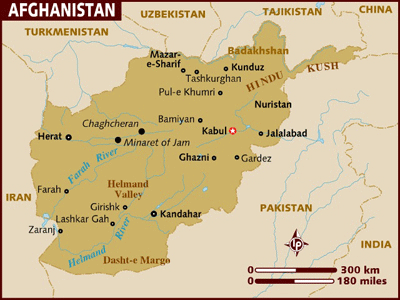
Afghanistan....the Graveyard of the Foreign Powers


*  A nation perpetually at war with itself. This is the common perception about Afghanistan the world over. 

*    With the exception of the introduction of Islam in 642 AD, it took almost two–centuries to finally embed Islam in Afghanistan, no foreign power has been able to establish a social contract between the central Government in Kabul and villages across the rural heartland. 

*  The reason is that the western powers, who considered Afghanis little less than barbarians, never understood the psyche of the common folks in Afghanistan. The Afghanis through ages have resisted any foreign attempts to bring about change in their social life. Why are they averse to change? this will boggle any human mind.

*   Alexander faced fierce resistance in the Afghan tribal areas and he is said to have commented that Afghanistan is "easy to march into, hard to march out of.” Genghis Khan had applied the most brutal measures during invasion in 1220, but failed.

*    The British forces faced a disaster during withdrawal at the end of the first Anglo-Afghan War (1839-1842). During retreat over the mountain passes outside Kabul, about 4,500 British soldiers and 12,500 civilians died. 

*    During the second Anglo-Afghan War a young British soldier, Winston Churchill fought in the battle. Churchill wrote of British exploits in Afghanistan, as “Financially ruinous, morally wicked."  

* The Russians during their ten-year occupation of Afghanistan learned the lesson the harder way and paid with the lives of thousands of their soldiers. They faced humiliation and defeat before they took the decision to withdraw.  

*   It seems that the foreign powers get trapped by Afghanistan in their quest to improve the social structure in that country, and have a foot in this strategically located nation. 

*    Often the foreign powers suffer from a notion that their choices are correct, and thus invest so much in there. But in the end they leave Afghanistan, empty handed. The fate of the NATO forces doesn't seem to be any different that of their predecessors. 

* Sadly, Afghanistan remains a graveyard for the foreign powers.


Thursday, 15 January 2015

Magic of Mikhail Sholokhov..


*    The books describes about the lives and struggles of the Don Cossacks during the First World War, the Russian Revolution, and the Russian Civil War. Arguably it is the best book written about the race that has captured the imagination of readers from across the world. It's Sholokhov's masterpiece and he deservedly got the Nobel for this. 

*   Not even Leo Tolstoy, Russia's greatest writer (no offence meant to him and one of my favourite authors) could depict the lives of cossacks better in his book, 'The Cossacks'. I don't wish to spoil your mood by writing more about this classic. 

*     A must read for book lovers......

Thursday, 1 January 2015

A New Year of Challenge !


*     Wishing you all a Happy and Peaceful New Year.

*      While this year brings hopes and aspirations for millions of us who live in safety of our homes, the year poses a great challenge for thousands of people living in Iraq and Syria where the Islamic State is butchering human beings. The women are being  abused, and then sold. The young boys are forced to join their ranks, and trained to kill.

*    Since the World War II, the innocent civilian population has never been so threatened. What's worrying is that the efforts of the civilized nations so far haven't been able to contain the menace of the Islamic State. 

*     People who are suffering and fighting the atrocities of these newest and cruelest terrorists, deserve our prayers.


Related Posts with Thumbnails